This is a side observation. It surfaced while we were deep in the infrastructure work at BlueNexusAI and started to see a pattern playing out across the verticals our customers operate in.
I sat on it over the weekend trying to figure out if it was as significant as it felt. I've concluded it is, at least for the people who see it early. So I want to share it here as a genuine heads up, for anyone sitting inside a commercial supply relationship right now.
I'm calling it the Agentic Economic Concept of Default Distribution Dominance, or Default Distribution Dominance for short. I think it describes something that's going to reshape how procurement works across almost every industry over the next three years, and fewer than one in twenty five commercial operators currently understands it well enough to act on it.
The history of defaults is the history of money
Every major shift in commercial distribution has really been a story about defaults (no not the credit type). The company that became the default destination for a buying behaviour didn't just win customers. They captured the economic value of that entire behaviour at scale.
When Google became the default search engine embedded in browsers, devices, and operating systems, they owned the moment every person on the planet reached for information. Building a better directory was never the play. Every query that went through Google was a procurement moment, a buyer expressing intent, and Google sat at the exact point where that intent surfaced. The advertising business that followed was simply the monetisation of owning that moment at scale.
When Netflix became the default delivery mechanism for home entertainment, they won by being there, in the living room, frictionless, already opened, before Blockbuster understood that the living room was the battlefield. Content quality came later.
When Shopify became the default infrastructure for independent commerce, they won because every merchant who built on Shopify was building their commercial identity around Shopify's defaults. Payment flows, storefront templates, analytics. Each one a default that compounded into lock-in. Technical checkout superiority was never the reason.
In every case, the company that won the default position competed for position, arriving at the moment of decision before anyone else did. Once there, inertia did the rest. Defaults are sticky, and changing them costs real effort. Most people never do.
That mechanic is about to play out again, at an enormous scale, inside AI agents.
What Default Distribution Dominance actually means
Default Distribution Dominance is what happens when a supplier earns a position inside an AI agent's default routing logic and that routing becomes the permanent procurement channel for every user that agent serves.
The economic principle beneath it is straightforward. Agents route. They follow their operational logic rather than browsing, comparing, or considering. An agent calls the suppliers, systems, and services that were wired into it at the moment it was built, through MCP connectors. It executes those routing decisions automatically, repeatedly, without comparison shopping, without responding to an ad, without a sales rep having any influence over the outcome.
The supplier wired into that logic, through their MCP-connected backend inventory system, wins the transaction every time the agent runs. The supplier who isn't wired in is simply not in consideration. They might have equivalent pricing, comparable quality, and the same salespeople. They don't exist inside the workflow, so the workflow doesn't reach them.
Once the default is set, the economic structure runs automatically.
The infrastructure making it possible right now
The technical primitive that enables Default Distribution Dominance has a name: Model Context Protocol, or MCP. It's an open standard now backed by Anthropic, OpenAI, Microsoft, and Amazon Web Services (AWS). As of early 2026, there are over ten thousand active public MCP servers and nearly a hundred million monthly SDK downloads. This is no longer an experiment. It is mature infrastructure.
What a supplier needs to claim a Default Distribution Dominance position is not complicated. An MCP server or an API endpoint, a relationship with the right agent builders in their vertical, and the understanding that what they're building is a distribution channel, one that operates every hour, never forgets preferred suppliers, and compounds with every new agent that wires into it.
Gartner currently projects that by 2028, 90% of B2B buying will be AI agent-intermediated, routing more than fifteen trillion dollars through agent exchanges. The economic scale of what's moving to this layer is not marginal. It's the entire mechanics of commercial procurement shifting infrastructure.
The entry cost for a supplier is a fraction of what a traditional distribution infrastructure investment looks like. The moat that follows is structural, and once established, extremely difficult for a competitor to dislodge.
What this looks like in practice
Supermarket Supply Dominance
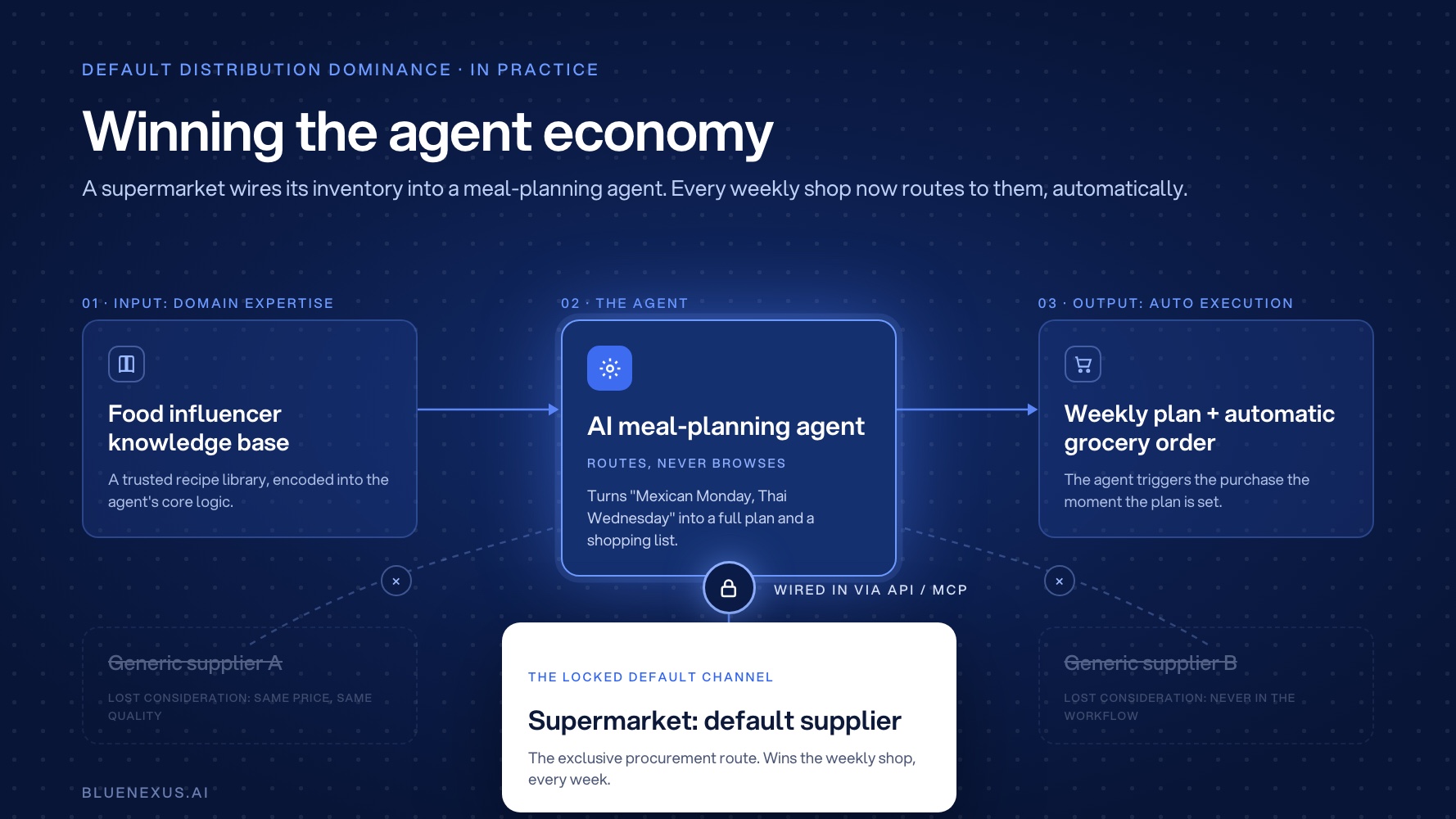
A large supermarket chain partners with a food influencer who has millions of followers and a deep, trusted recipe library. Together they build a meal planning agent. A family uses it on Sunday evening to plan their week. They describe what they feel like eating, Mexican Monday, Italian Tuesday, Thai Wednesday. The agent draws on the influencer's knowledge base, builds the full meal plan, generates the shopping list, and places the grocery order automatically, directly to the supermarket, because the supermarket built their inventory connection into the agent's backend from the start.
The family signed up because they love the influencer. They stay because the agent saves them an hour of mental load every week. The supermarket earns the grocery order before the family opens a browser. Competing supermarkets retain their pricing and their product quality. What they no longer have is access to the procurement decision, because that decision is now happening inside the agent, and the default is already set.
Construction Wholesale Supplies
Take a trades business. A plumber builds a job management agent to handle quotes, customer emails, and parts ordering. The agent connects to a single plumbing supplier through their API, the supplier the plumber already trusted and chose to wire in when they built it. Every job that comes in now triggers an automatic parts order to the same supplier. The supplier, recognising what they have, takes the agent to every other plumber in their network. A corner of the market closes quietly. Competing suppliers still have their catalogue and their sales team. They no longer have access to the procurement moment, because that moment moved inside the agent and the default position belongs to someone else.
Healthcare and Medical Supplies
A clinician builds a patient management agent that handles scheduling, care protocols, and supplement recommendations. The agent connects to a pharmaceutical distributor whose products the clinician already uses and trusts. The distributor takes the agent to their broader network of clinicians. Every clinician who adopts it routes their procurement through the same default. The distributor doesn't just have a sales channel. They have a trusted recommendation channel, running continuously, at scale, embedded inside the most trusted professional relationship in their customers' lives.
The pattern is identical across every vertical where there is a buyer and a seller. The specific domain doesn't matter. The only thing that does matter is who got into the agent first.
Why this is an economic concept, not just a strategy
A tactical play is something you do to improve your position in the existing game. A pricing adjustment. A new channel. A better ad. Default Distribution Dominance describes something structural. It maps how economic value is going to be allocated in the agent era, at the architecture level, before any individual sale takes place.
In traditional commerce, economic value flows to the supplier who wins the moment of consideration. You surface at the right time, with the right message, to a buyer who is actively comparing.
As the agent economy takes hold, the moment of consideration has moved. It happened when the agent was built, when the builder chose which suppliers to wire into the routing logic. Every transaction that follows is a downstream consequence of that original architectural decision. The agent executes. The buyer's moment of choice already passed, at the point of build.
Here is the layer beneath that most people haven't reached yet. The agent builder, the plumber, the clinician, the food influencer, chooses which supplier to wire in based on who they already trust, who reached out to them, who made themselves accessible at the right moment. In one version of this, the supplier waits to be discovered and chosen.
The more direct path (and the notion I'm hoping to wake people up to in writing this article) is available to any supplier with a product to sell. Build an agent that makes your customers' working lives genuinely easier. Wire your own API into the procurement layer of that workflow as the default channel. Adoption follows value. Default Distribution Dominance follows adoption. The distribution position is a structural output of the useful thing you built, not a separate initiative running alongside it.
The plumber scenario makes this concrete. An agent that handles quotes, customer emails, and parts ordering saves a working tradesperson several hours every week. That utility is what earns adoption. Every parts order routing automatically to the supplier's API is the Default Distribution Dominance position in action. The plumber signed up for an admin tool that makes their job easier. The supplier built the admin tool knowing procurement came with it.
The window is open and it won't stay that way
Fewer than twenty-five percent of B2B suppliers are doing anything meaningful with agentic AI right now. Most commercial operators I speak to are still treating AI as a productivity tool, something to write faster emails, save a few hours a week. The shift to understanding agents as distribution infrastructure, and acting on that understanding, hasn't happened yet for most of them.
There's something I find almost poetic about the way these moments play out. The technology announces itself loudly, everyone nods, and then almost nobody acts. The few who do act move so far ahead that by the time the rest understand it, the ground is already divided.
Suppliers who move now, in a bid to corner the market early, are building distribution assets that compound. An MCP server wired into a hundred agents across a vertical is a hundred procurement channels running on autopilot. Each one adds to the Default Distribution Dominance position. Each one makes the competitor's path harder.
Changing a default in an established agent workflow isn't like switching a preferred supplier on a vendor list. It requires the agent builder to deliberately rebuild part of their operational logic. That's a switching cost problem, not a marketing problem. Switching costs in embedded systems are high. Default Distribution Dominance, once established, is genuinely difficult to dislodge.
The companies that will own distribution in the agent economy are those who understood, early enough, that the procurement decision had moved to a new layer, and who placed themselves in that layer before the defaults hardened. Having the best product is not the deciding factor.
A question worth asking, then acting on!
BlueNexus isn't selling this, we noticed it as a fringe benefit that our product can offer. A side effect of going deep enough into how agentic workflows actually function that the commercial implications became impossible to ignore. The observation felt important enough to share, because the window it describes is genuinely finite and most people don't know it's closing.
If your business sits in a buy/sell relationship, and most do, ask yourself:
What kind of genuinely helpful agent you could build for your customers or your channel partners that would also secure this procurement flow for your company?
The best Default Distribution Dominance plays won't feel like distribution grabs to the people who use them. They'll feel like useful tools, with the Default Distribution Dominance layer sitting subtly below the surface. The plumber's job management agent is a gift from the supplier to the plumber. The meal planning agent is a gift from the supermarket to the family. The moat is a byproduct of the value, not the point of it.
Originally published on LinkedIn.