The best products tend to come from internal necessity, you know, someone scratching their own itch rather than chasing a market. There's a second, edgier perspective to this though, the discipline to notice when the thing you are building is not yet the thing the market needs, and to move to the one it does. Realising the latter often leads to the former, and thats how we arrived at what BlueNexus is today, a true MultiPlayer AI Native workspace where humans and agents collaborate, just like a normal brick and morter office, but digitised and brought to LIFE!
Where we started
We set out to solve something real, how businesses get the right data to their AI agents, and how they build with those agents safely. We were building for where AI is clearly heading. People understood the vision the moment they saw it. The trouble was timing. In conversation after conversation, the practical use kept sitting just out of reach. Why? Because enterprises were still wrangling with how to adopt AI internally. They were no where near ready to start baking agents into their own products. We underestimated the AI proficiency of our ICP's.
What the market actually told us
We listened, and what we heard reframed the BlueNexus product position. The enterprises we assumed had their AI act together mostly did not. Plenty were not doing enterprise AI in any real sense at all. The ones using it internally were doing it in a fragmented, broken way: a different tool in every department, none of them connected, context stranded in silos, agents that forgot everything the moment someone changed tabs. The lifeblood was not circulating. Inside, a lot of these organisations looked like a tombstone with a logo on it.
Finding the vertical
It was at this point we realized we were barking up the wrong tree. The real problem came into focus, and with it, our vertical. We had been solving a problem companies would have in a couple of years. The one they had right now was simpler and more urgent. They are not adopting AI properly because they do not know how, and they do not have the infrastructure to do it safely. So we pivoted, once and with conviction, to building that infrastructure. A pivot usually isnt an easy decision to make, but for us it was. Why? Because we had already built the solution for ourselves internally. We just assumed the market wouldn't have an appetite for it, it turns out, they did.
The pivot was fast, because we had already built it. For ourselves.
We had been living the problem
Our own team had been stuck in the exact pain we kept hearing about. Work spread across eleven tabs, each one its own little data silo, context copy-pasted from one tool to the next, agents that were sharp alone and useless together because none of them shared memory. We had quietly built a workspace to fix our own days. We did this because as a remote team, ensuring each department, each project & each workflow having the right data and context was paramount to running a smooth operation within an AI native setting. It turned out that was the product the market was actually asking for.
BlueNexus is a governed, AI-native workspace that sits on top of the tools a business already uses. People and their AI agents share the same documents, permissions and memory, so context moves through the company instead of getting trapped between apps. Agents get logins and do real work. Humans stay in control. Everything is logged.
What this looks like in practice: before vs after
A launch, across finance, PR and sales.
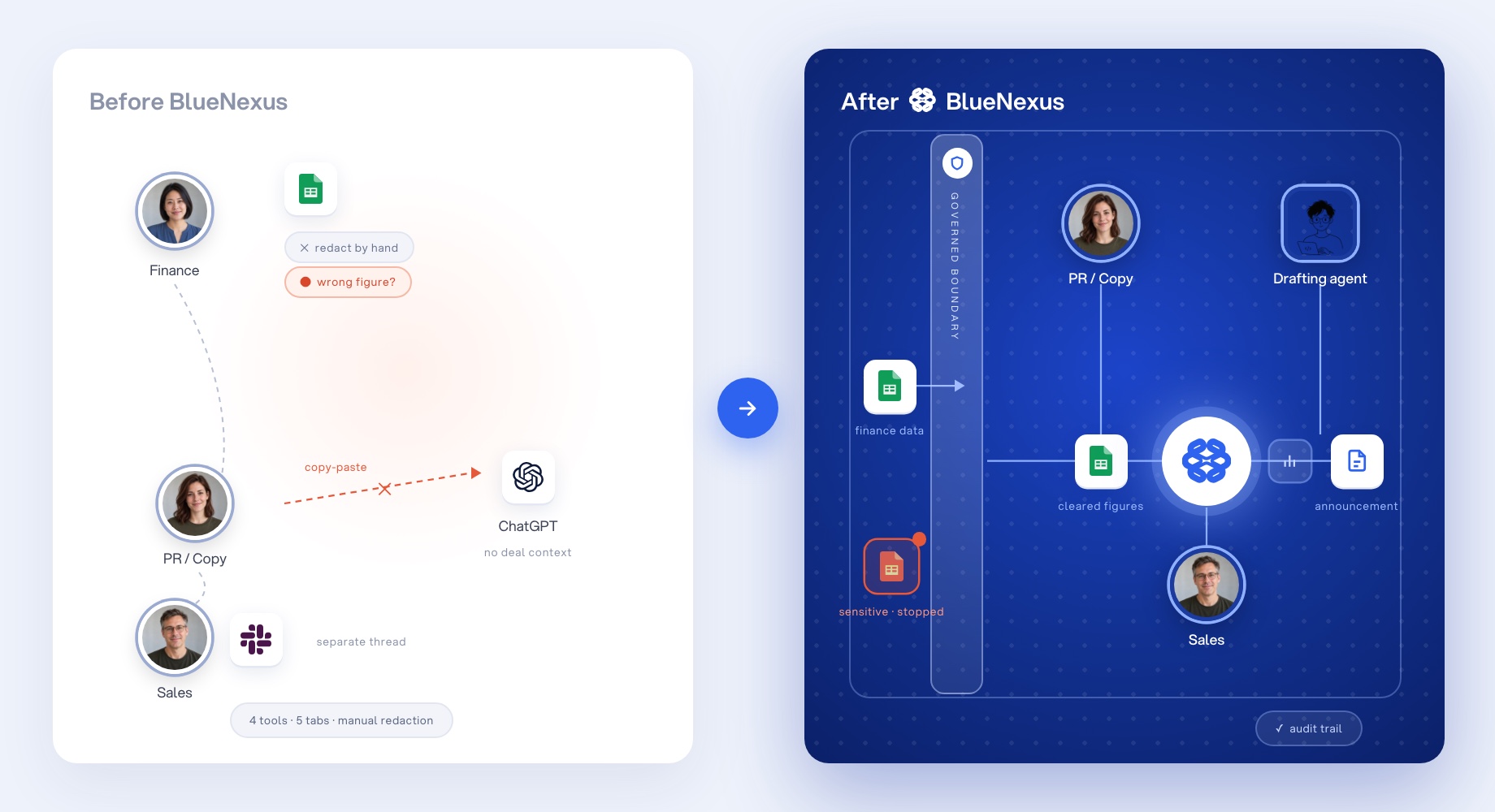
Without BlueNexus: PR is writing an announcement and needs the factual numbers, especially if its linked to a companies finance. So the copywriter from marketing email's finance, who send back a spreadsheet that also holds figures nobody outside finance should see, and someone redacts it by hand before it goes further. PR pastes the cleared numbers into an AI tool that knows nothing about the deal, drafts the copy, and forwards it to sales in a separate thread. Four tools, a manual redaction, uploads, downloads, multiple agents in siloed context / inference . . . a genuine chance the wrong figure ends up in public.
With BlueNexus: the launch sits inside a shared project in one shared workspace. Finance connects its data through a governed connector, and permissioning means PR and sales only ever see the figures cleared for the announcement. The sensitive numbers are obfuscated by the delegate agent, meaning only the right people see the right data. Best practice governance. The drafting agent already has the deal context and the guardrails in the room. Sales pulls the same approved talking points from the same place. No redaction scramble, no version chaos, and a full record of where every number came from.
A project across the team, the version we lived ourselves.
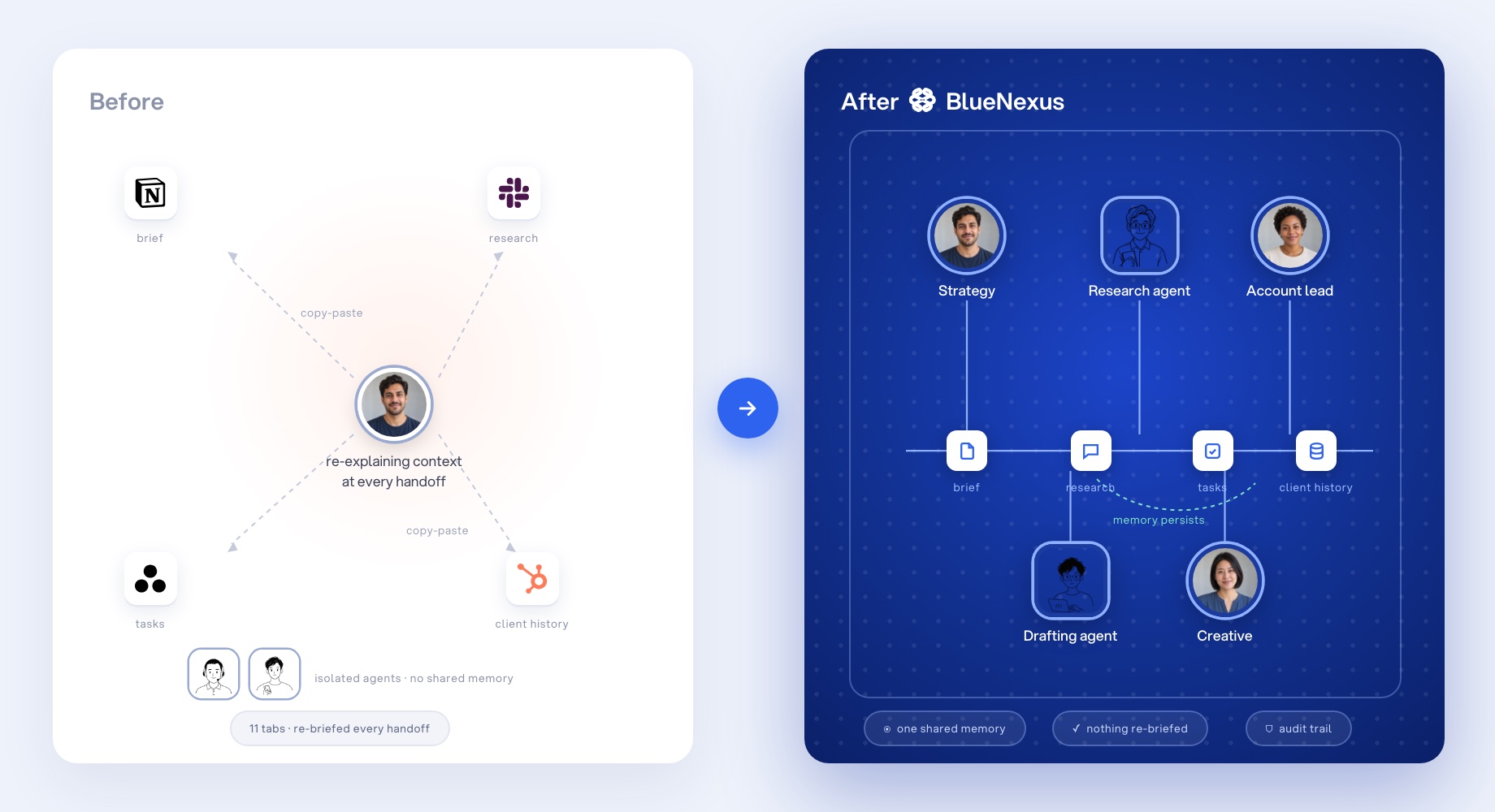
Before: when our team ran a project, the brief lived in a doc, the research in a chat, the tasks in a third tool, the client history in a fourth. Every handoff meant re-explaining the context to the next person, and to whatever AI they happened to be using. We were the eleven-tabs company we kept diagnosing in everyone else.
After: the project is one space. People and agents work from the same brief, the same history, the same thread. The agent that did the research still has it when it helps with the draft. Nothing gets re-briefed, nothing gets lost in a handoff, and we can see exactly what every agent did. We fixed our own days first, which is the only reason we trust it in anyone else's.
The lesson, and the discovery
If there is a lesson in it, it is this. Build from your own necessity, listen hard enough to know when your instinct is early, and pivot to the problem in front of people with conviction. Your vertical is usually hiding in the gap between what you want to build and what people are ready to buy.
The technology to fix this has existed for a while. What has been missing is a place to put it that a whole team can trust. We built that place because we needed it. If your company has "adopted AI" and still feels like a set of sealed rooms, lets have a chat.
We are opening a first pilot cohort of small and mid-sized businesses, and building a partner network for the consultancies who implement this for a living. If either is you, feel free to get in touch.
Originally published on LinkedIn.