Last week I had a three-hour round trip to get my daughter to an appointment. I was mid-build on an agent design I couldn't put down, so I did what any parent with a deadline does. I kept working. Text-to-speech on. Voice notes going back and forth with Lume, the parent agent I'd been scaffolding for weeks. (Eyes on the road, don't worry.)
Father and co-founder of a busy startup here. Being busy doesn't mean you should abandon your family. Smart founders blend the two. In this case, I turned work into an AI learning opportunity for my daughter. Get creative with work/life balance.
An hour in, my daughter started listening. Not to the work, exactly. To the shape of it. By the return leg she was asking better questions than most of the AI tinkerers I talk to.
"Why does the big agent need a small agent? Can't it just do the thing itself?"
"How does it know what to remember?"
"What happens when it gets confused?"
She is Seven. She has never written code. And somewhere between the on-ramp and the parking lot, she reframed the problem I've been circling at work for months.
The real barrier to AI agent adoption isn't capability
Some of my work right now lives inside a problem I'd call complexity abstraction for agent composition. Plain-English version: how do you let someone who isn't a developer build something useful with AI agents, without asking them to carry a forty-page architecture doc in their head?
Most agent frameworks today quietly assume you already know what a tool call is, how to scope state, what a system prompt does, and where your context window is about to blow up. For a novice, it's a vertical cliff. They either bounce off or they build something brittle and blame themselves when it breaks.
The models are good enough. The methods are getting better. What's actually missing is a way to build with them that doesn't require understanding too much at once.
My daughter didn't know any of this. She just kept asking the questions I'd stopped letting myself ask.
What started as a daddy-daughter experiment
By the time we pulled into the driveway, we had the shape of something. A work obligation on a three-hour drive had turned into a proper experiment.
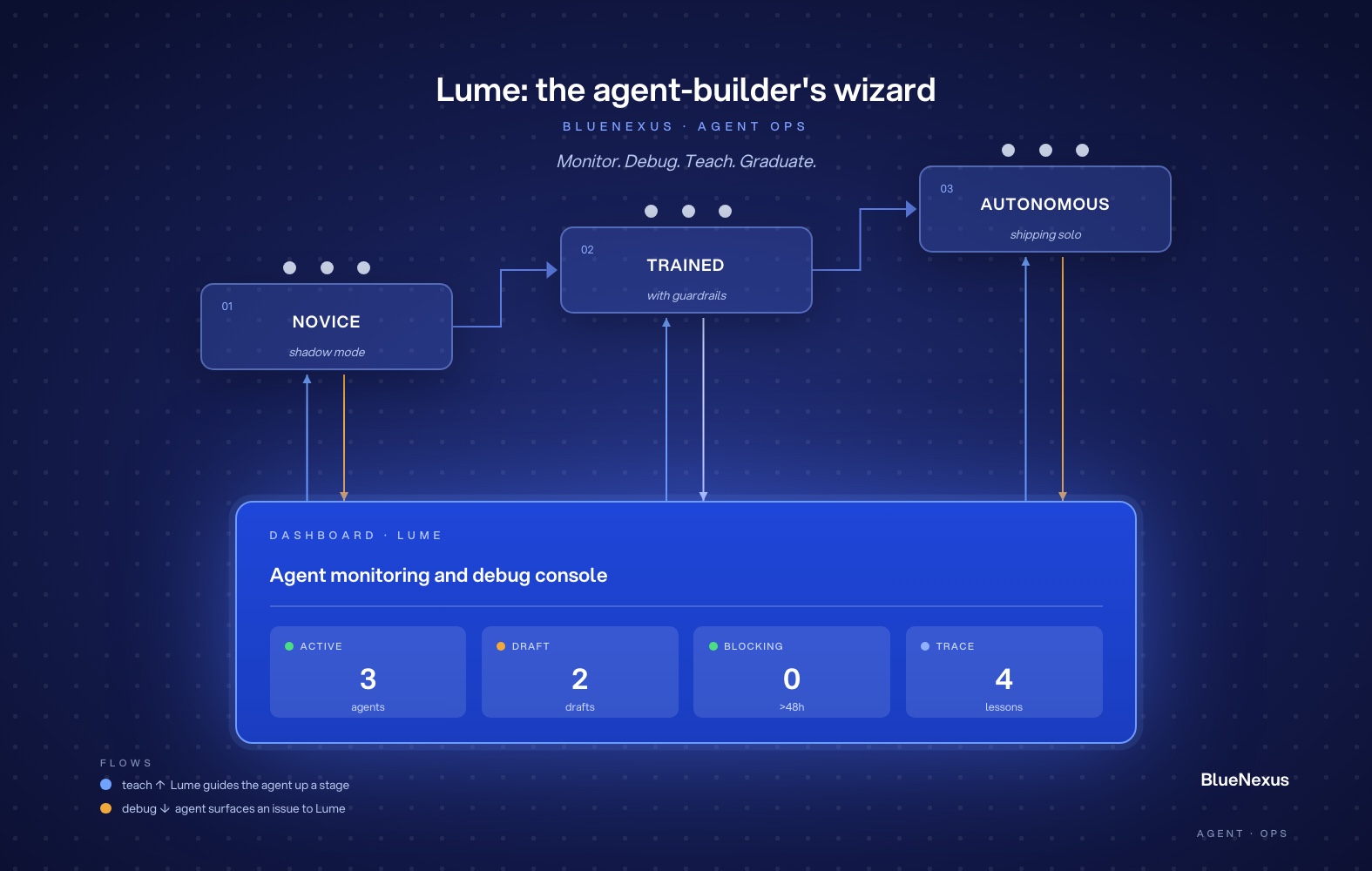
The idea: use a parent agent as the scaffold.
Lume isn't the agent that does the work. Lume is the agent that absorbs the work of getting to the work. The research. The debug loops. The false starts. The dead-end experiments from three weeks ago you'd otherwise forget existed. Lume holds all of it, so the human doesn't have to.
While I'm building our marketing agent, Lume is the context layer underneath. Lume remembers what we tried. Lume reads the docs I haven't gotten to. Lume catches the drift when I'm about to repeat a mistake.
The human stays at the altitude they're actually good at: intent, judgment, taste. The parent agent handles the undertow.
My daughter, the complete novice, helped me architect this.
What's working
The parent agent is a memory layer, not a manager. Lume's only job is to make sure nothing we learn gets lost. Every dead end, every oh, that's why, every half-baked idea I'll want again in a month. That alone has changed the pace of building.
Novices don't need less complexity. They need less exposed complexity. My first instinct was to strip the framework down. That version flopped. The version that worked kept the full power underneath and put a conversational parent agent on top.
Debugging is faster when the parent agent has seen the whole journey. Fresh eyes miss context. Lume doesn't.
What's not working
Don't make the parent agent the doer. Early versions had Lume trying to execute the marketing work itself. Wrong fit. A parent agent's leverage is meta. It thinks about the thinking. The moment you promote it to operator, you've lost the scaffold.
Don't over-index on autonomy. A parent agent that silently "runs in the background" is a parent agent that's quietly drifting from your intent. Tight turns. Frequent check-ins. Explicit handoffs.
Don't skip memory hygiene. If the parent agent is your learning layer and that layer gets polluted with stale facts, duplicate entries, and abandoned threads, the whole system degrades. The boring maintenance work is the work.
Don't conflate helpful and capable. A parent agent that narrates confidently but recalls poorly is worse than no parent agent at all. Accuracy over affect.
What my daughter actually showed me from the perspective of a novice
Her question was "can't the big agent just do it?" Sometimes, yes. But that's the wrong question for someone about to start building.
The right question is narrower and more useful:
What is the smallest amount of complexity a human needs to see to make a good decision, and where does everything else live?
For us, everything else lives in the parent agent. The novice (my seven year old, or the marketer who wants to build her first agent next year) stays in the seat they're meant to sit in. The scaffold holds the rest.
If the next wave of AI adoption is going to reach people who aren't developers, someone has to solve this. Smarter models won't. Better docs won't. The reader has to carry less state in their head, not more.
We drove home. My daughter asked if she could "run the parent agent" next time. I told her she already had.
I'll share more as this experiment runs. But if the people you're building for keep getting stuck at the same place, I'd gently suggest it may not be a UX problem. It may be that you've asked them to hold too much state in their head.
Scaffold that. Then see what they build.
Originally published on LinkedIn.